
Fuse X1 Industrial SLS System Launch
A technical evaluation of the selective laser sintering platform built for serial polymer manufacturing with an expansive 330x330x565 mm chamber.
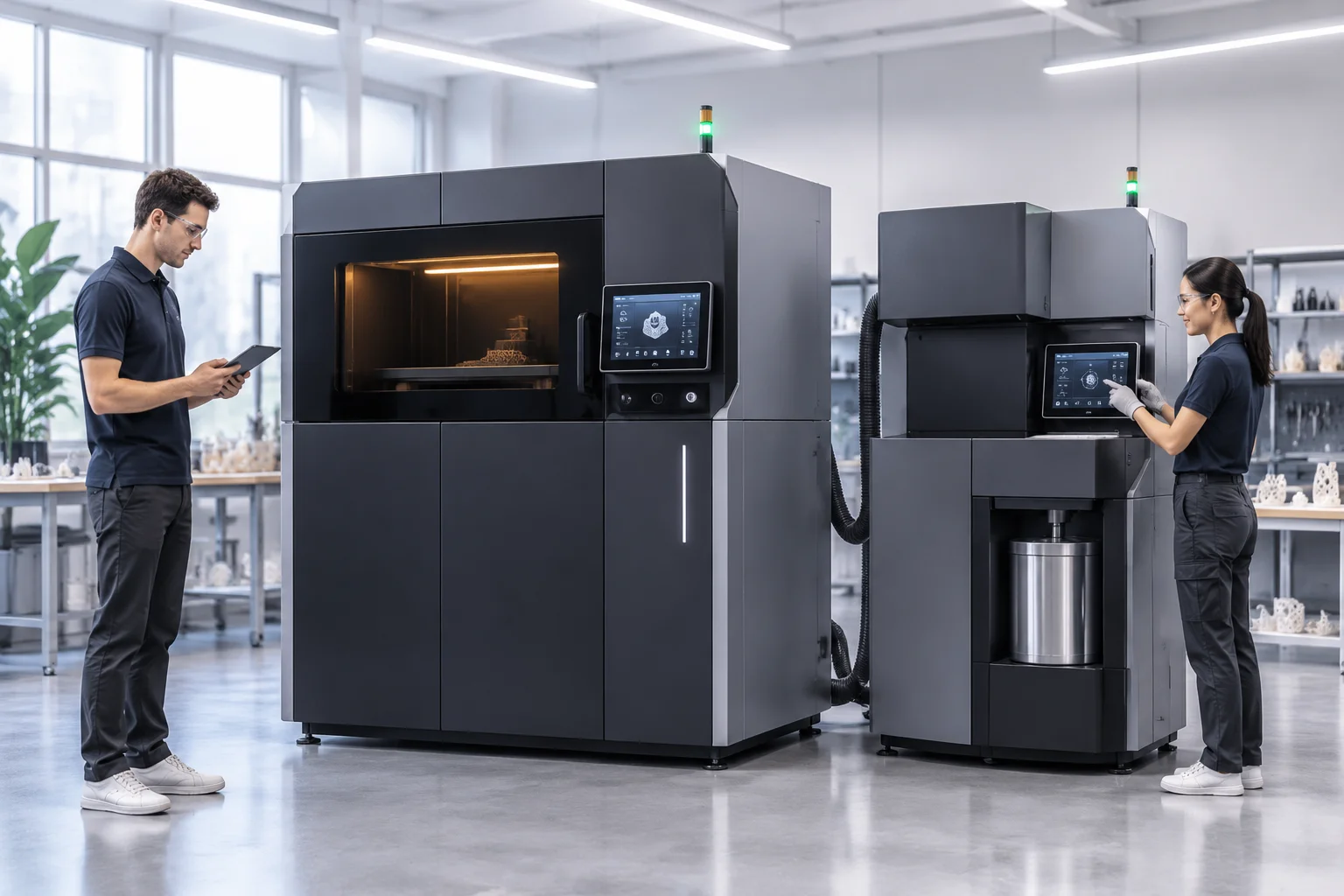
Expanded Selective Sintering Envelope for Production Runs
The Fuse X1 industrial platform solves production volume restrictions by delivering an expanded 330x330x565 mm internal build envelope. Engineered specifically for complex assemblies and high-density batch nesting, the unit pairs an inert gas management unit with high-speed galvanometer scanning to eliminate structural variances across all vertical zones.
Operational Parameters & Process Specifications
| Parameter | Value / Technical Scope |
|---|---|
| Usable Build Cylinder | 330 x 330 x 565 mm (61.5 Liters Total Volume) |
| Laser Source & Focus | 60W CO2 Laser with Dynamic Beam Focus Module |
| Layer Resolution | 80 to 120 microns (Calibrated Nominal 100 µm) |
| Supported Thermoplastics | PA11, PA12, Glass Bead Filled PA, Flexible TPU |
| Atmosphere Regulation | Active Nitrogen Inertization System (<0.5% Residual O2) |
| Material Turnover Ratio | 30% Virgin to 70% Recycled Powder Blend Baseline |
- The 565 mm vertical build dimension accommodates full-length structural ducting and housings without requiring mechanical segmentation.
- Automated powder sifting and mixing maintains an economical 30% virgin powder refresh threshold during standard PA12 manufacturing cycles.
- Active nitrogen purging inside the chamber prevents thermal degradation and secures uniform tensile properties across all spatial axes.
Active Thermal Boundary Control Across Extended Multi-Day Jobs
During selective laser sintering jobs running over forty continuous hours, maintaining strict thermal equilibrium between the outer edges of the powder cake and its interior core is critical. The Fuse X1 integrates sixteen independent quartz heating elements mapped directly above the bed surface. An array of calibrated optical pyrometers scans the entire powder plane, providing fast feedback loops that adjust heat flux across peripheral zones and keep temperature variations strictly within a narrow ±1.2°C window.
The recoating system utilizes a bi-directional counter-rotating cylinder assembly that applies uniform compression to freshly distributed polymer granules. By eliminating micro-grooves and localized density drops during deposition, the platform supports compact packing configurations up to 18% volumetric density. As a result, print preparation teams can bundle diverse component shapes into a single run without risking premature curling or unbonded edges.
Expanding the vertical chamber coordinate to 565 mm changes how additive layouts are arranged. Complex geometric ducting that previously required split sections can now be positioned upright in one unbroken pass.