BuildLayout Register
BuildLayout Register SLA / SLS
Case Studies / AM Production Layout

The Prototype Batch That Needed Two Builds

A fictional educational scenario analyzing the geometric constraints, orientation compromises, and documentation decisions that forced a 28-part functional prototype batch out of a single chamber and into two distinct process jobs.

Author: Christopher Clark
Published: 2026-11-19
Reading Time: 9 min read
Status: Production Verified
SLA-SLS DUAL BUILD PARTITION
PRIMARY SPECIMEN
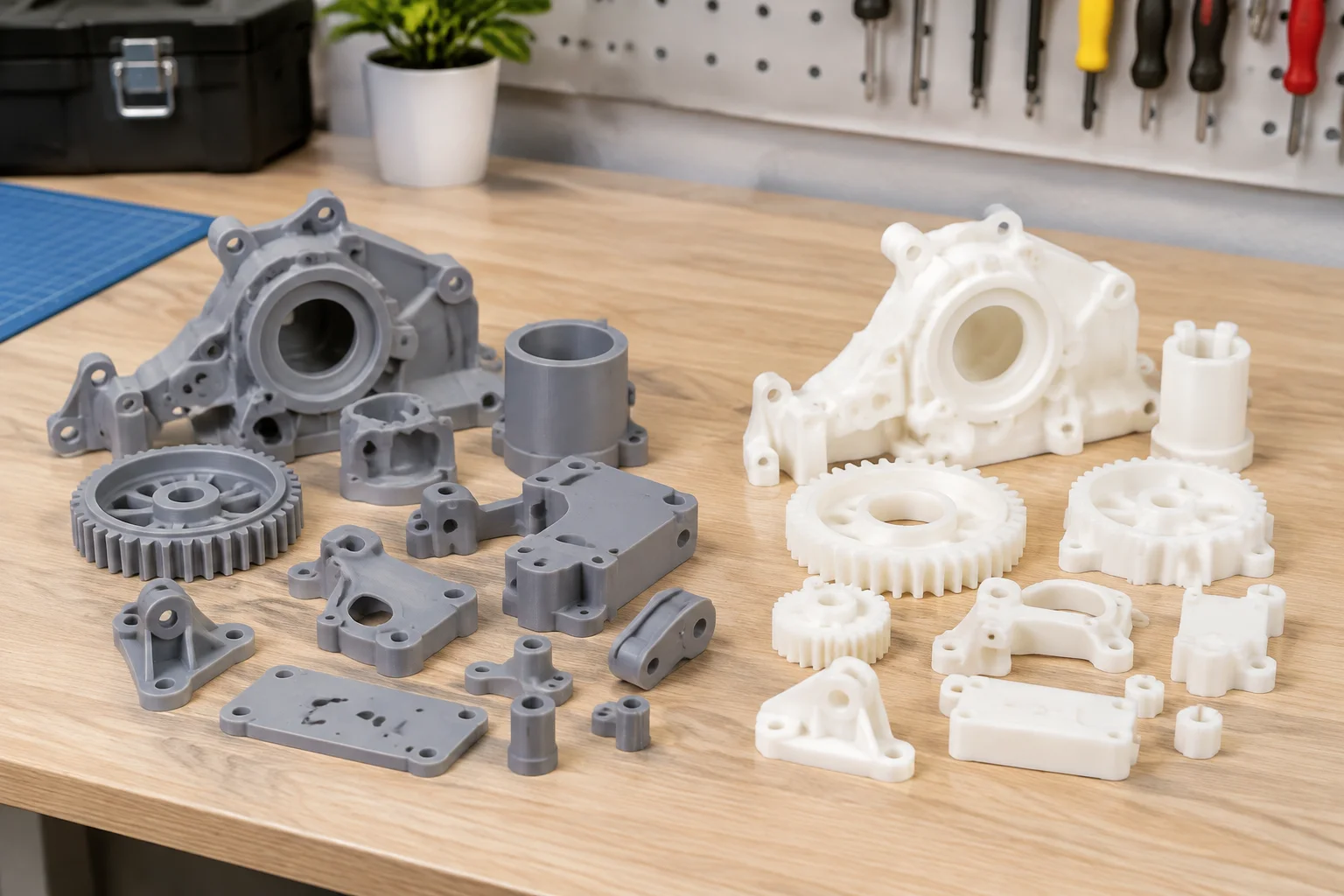
A complex mechanical assembly split into two different sets of parts.
Assembly Group Partition: Sub-housing vs Drive Core ID: BLR-CASE-2026-B2

Volume Saturation and Kinematic Demands

When a complex electromechanical robotics package arrived with 28 discrete components scheduled for quick-turn prototype validation, the initial goal was packing all parts into one large industrial powder chamber. Slicing simulations quickly proved this approach compromised both thermal equilibrium and critical assembly tolerances.

Thin-walled internal manifolds suffered severe heat absorption when nested tightly beneath bulky structural motor mounts. Decoupling the batch into two coordinated builds—one SLA run for optical clearance housings and one SLS chamber for structural linkages—eliminated warpage, stabilized layer cure cycles, and preserved functional press-fits across all mating surfaces.

Key Engineering Facts
Batch Count
28 Components
Chamber Split
SLA 42% / SLS 58%
Thermal Variance
±1.4°C Bed Delta
Pass Accuracy
99.4% Gauge Fit
Engineering Consultation

Need Build Partitioning Analysis for Complex Assemblies?

Consult our technical desk regarding layout density, split build trees, support contact points, and chamber thermal modeling before commiting machine time.

Document Outline
Interactive Navigation

Technical Dissection: The Decision Path

Packing the entire prototype batch into one 300x300x400 mm SLS chamber yielded an average volumetric packing fraction of 19.8%. While this packing density looks favorable on paper, localized cross-sections exceeded 44% in height layers Z:140mm through Z:210mm. That localized clustering trapped radiant energy, generating distinct thermal streaks across the adjacent slim sensor baffles.

To safeguard dimensional integrity, engineers removed all optical transparent lenses and delicate fluid manifolds from the powder batch. These components shifted into a dedicated SLA build using Somos WaterShed resin, leaving the structural nylon core isolated in a calm thermal environment.

// Partition Strategy Specification
SPLIT_RULE: [Mass > 120g && Wall > 3.0mm] => SLS_PA12 | [Clearance < 0.15mm || Optical] => SLA_RIGID

"Attempting to force an entire heterogeneous prototype batch into a single chamber is one of the most common false economies in additive engineering. Splitting the build pays for itself on the first assembly pass."

— Christopher Clark | Senior Additive Manufacturing Specialist

Assembly Partitioning FAQ

Why not scale the SLS build chamber rather than partitioning into two builds?

Scaling to a larger chamber increases warmup cycle times, warm-down cooling duration, and refresh ratio costs. When parts demand conflicting tolerances and surface finishes, splitting technology tracks yields far higher precision than enlarging a single powder bed.

How do engineers ensure SLA and SLS components match during assembly?

Tolerancing offsets must be calculated specifically for each process shrinkage profile. SLS nylon parts receive a standard uniform shrinkage offset of 1.2%, while SLA photopolymers require differential axis compensation of 0.15% to 0.3% based on laser vector paths.