
Aerospace AM Systems Demand Growth
Analysis of the rise in demand for American AM systems across aerospace and defense sectors, examining large-format chamber adoption, repeatable laser sintering, and qualification protocols.
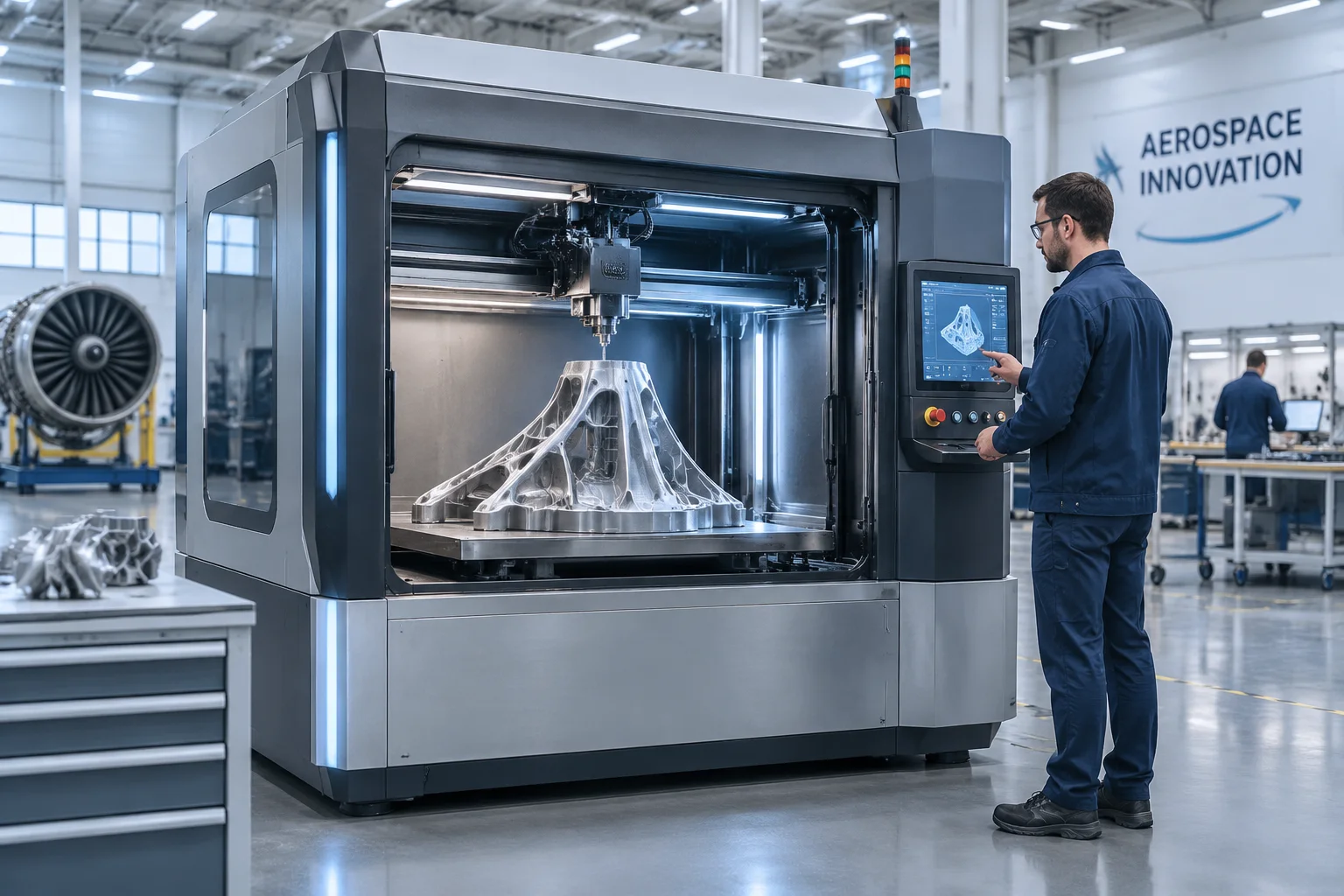
Accelerated Production Adoption Across Flight Hardware Programs
Aerospace prime contractors and commercial space launch operators are actively replacing legacy subcontracts with dedicated in-house additive manufacturing units. This strategic transition focuses on large-envelope powder bed fusion hardware capable of handling high-temperature polyamides and superalloy components under strict quality registries.
Flight-Grade System Operating Specifications
| Parameter | Value / Technical Scope |
|---|---|
| Build Envelope Target | 330 × 330 × 565 mm to 600 × 600 × 800 mm |
| Atmosphere Control | Sealed Argon / Nitrogen <50 ppm O2 |
| Material Processing Class | PA11-CF, PA12, Inconel 718, Ti-6Al-4V Gr 23 |
| Laser Configuration | Single to Quad Fiber Lasers (500W–1000W) |
| Layer Thickness Envelope | 30 µm to 120 µm calibrated steps |
| Data Compliance Framework | ITAR Controlled, ISO/IEC 25422:2025 (3MF) |
- Supply chain compression reducing subassembly lead times from 36 weeks down to 18 days.
- Integration of automated powder sieving and robotic breakout modules directly into flight manufacturing lines.
- Rigorous layer-by-layer optical emission monitoring enabling non-destructive evaluation during the active build.
Scaling Hardware Capacity and Closed-Loop Quality Verification
American defense suppliers increasingly deploy additive manufacturing hardware directly adjacent to flight assembly bays. This operational posture bypasses lengthy tooling vendor cycles for launch vehicle brackets, structural fairing clips, and environmental control ducting. Instead of producing temporary casting patterns, technicians feed validated slice models straight to multi-laser powder beds running round the clock under inert environments.
Process repeatability forms the cornerstone of this manufacturing growth. Modern installations monitor melt pool temperature, scan-speed dynamics, and powder layer uniformity in real time, cataloging sensor data points into immutable digital build records. In doing so, aerospace engineering teams verify metallurgical density and dimensional tolerances long before parts undergo secondary hot isostatic pressing.
The transition in aerospace additive equipment is no longer about proving part viability; it is about scaling continuous throughput and proving that every cubic centimeter of sintered material matches the nominal CAD database.