
Toolpath Extension Implementation
Deploying custom kinematic toolpaths, volumetric speed scaling, and vector extensions to eliminate boundary defects in industrial pre-print pipelines.
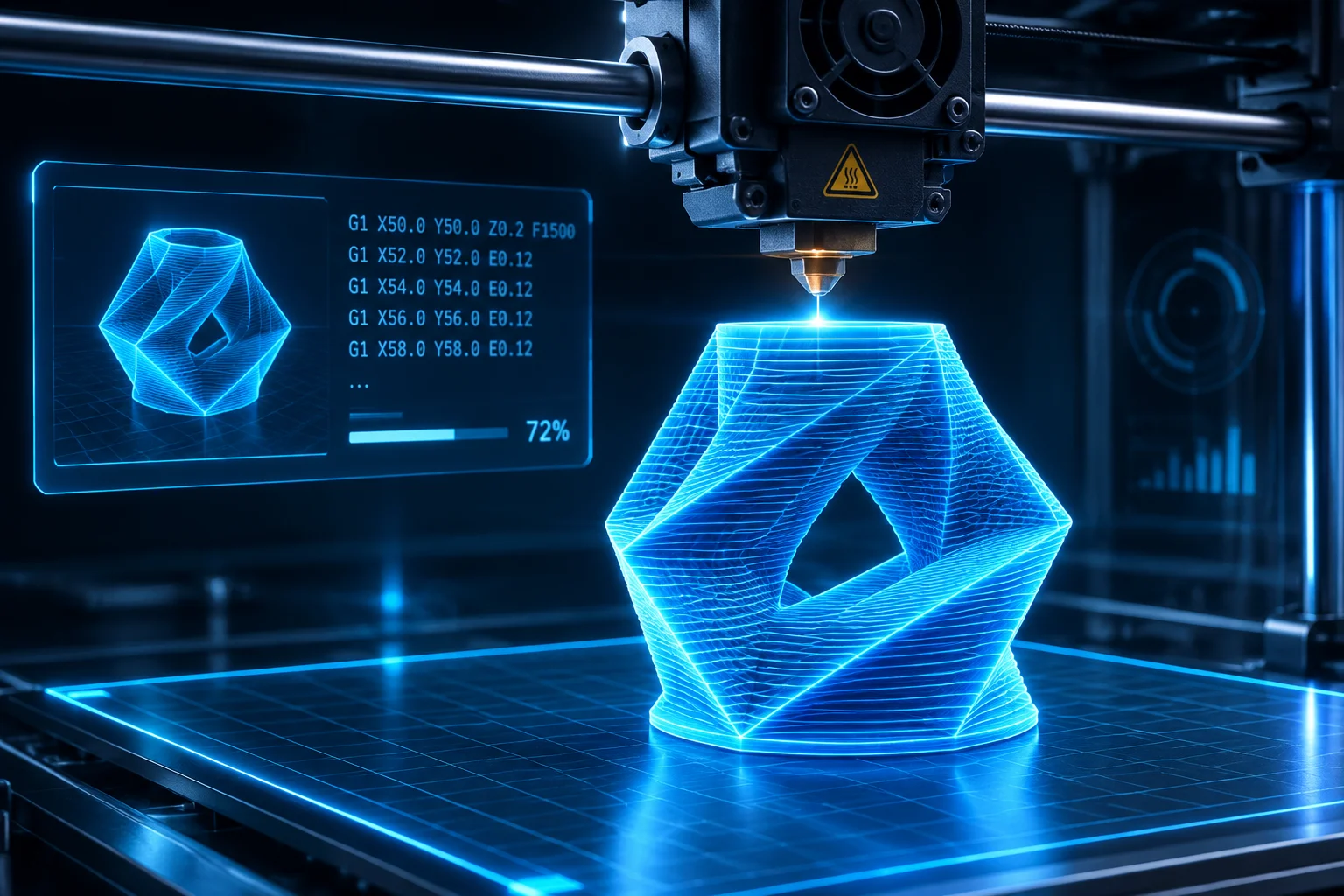
Precision Kinematic Planning for Advanced Slicing Engines
Standard slicing engines frequently treat planar toolpaths as isolated linear polyline contours, neglecting the micro-acceleration shifts and thermal continuity required across delicate additive features. Integrating specialized toolpath extensions into the preparation layer enables dynamic volumetric rate matching, continuous tangent angle preservation, and custom laser vector steering without altering CAD definitions.
Vector Interpolation & Parser Specifications
| Parameter | Value / Technical Scope |
|---|---|
| Interpolation Geometry | NURBS / B-Spline Continuous Path |
| Lookahead Depth | 128 Segment Smoothing Blocks |
| Chordal Deviation Limit | ±0.002 mm Tolerance Bound |
| Dynamic Rate Matching | Active Volumetric Flow Scaling |
| Supported Stream Formats | CLI v2.0, Extended G-code, SLC |
| Parser Step Latency | < 1.2 ms per kinematic cycle |
- Trajectory extensions eliminate localized over-curing and thermal pileup along tight contour radii.
- Buffer lookahead management diminishes sudden kinematic deceleration spikes down to negligible levels.
- Direct interpretation of high-order curves removes polyline discretization artifacts entirely.
Harmonizing Acceleration Curves and Volumetric Consistency
When configuring additive print cycles for tight mechanical tolerances, polyline segmentation often creates thousands of microscopic pauses. Each pause disrupts steady energy deposition, whether focusing a galvo scanner on an SLS bed or controlling an extrusion nozzle. Modern toolpath extension modules solve this friction point by translating linear segment bursts into continuous tangential arcs. The machine controller executes these arcs smoothly, dampening physical vibrations and stabilizing volumetric feed rates.
Slicing environments equipped with customizable toolpath extensions decouple machine-specific kinematic profiles from the primary part geometry. Operators can dial in custom acceleration curves, dwell times, and laser lead-in vectors without touching the master design file. This modularity streamlines iterative testing while establishing repeatable, audit-ready manufacturing records that conform to international additive protocols.
Direct vector interpolation transforms rigid motion commands into fluid, machine-adaptive trajectories that eliminate boundary seam defects at their physical source.