
SLA Parameter Setup and Optimization
Configuring laser focus, energy dosage, and wiper kinematics for specialized flame-retardant stereolithography resins.
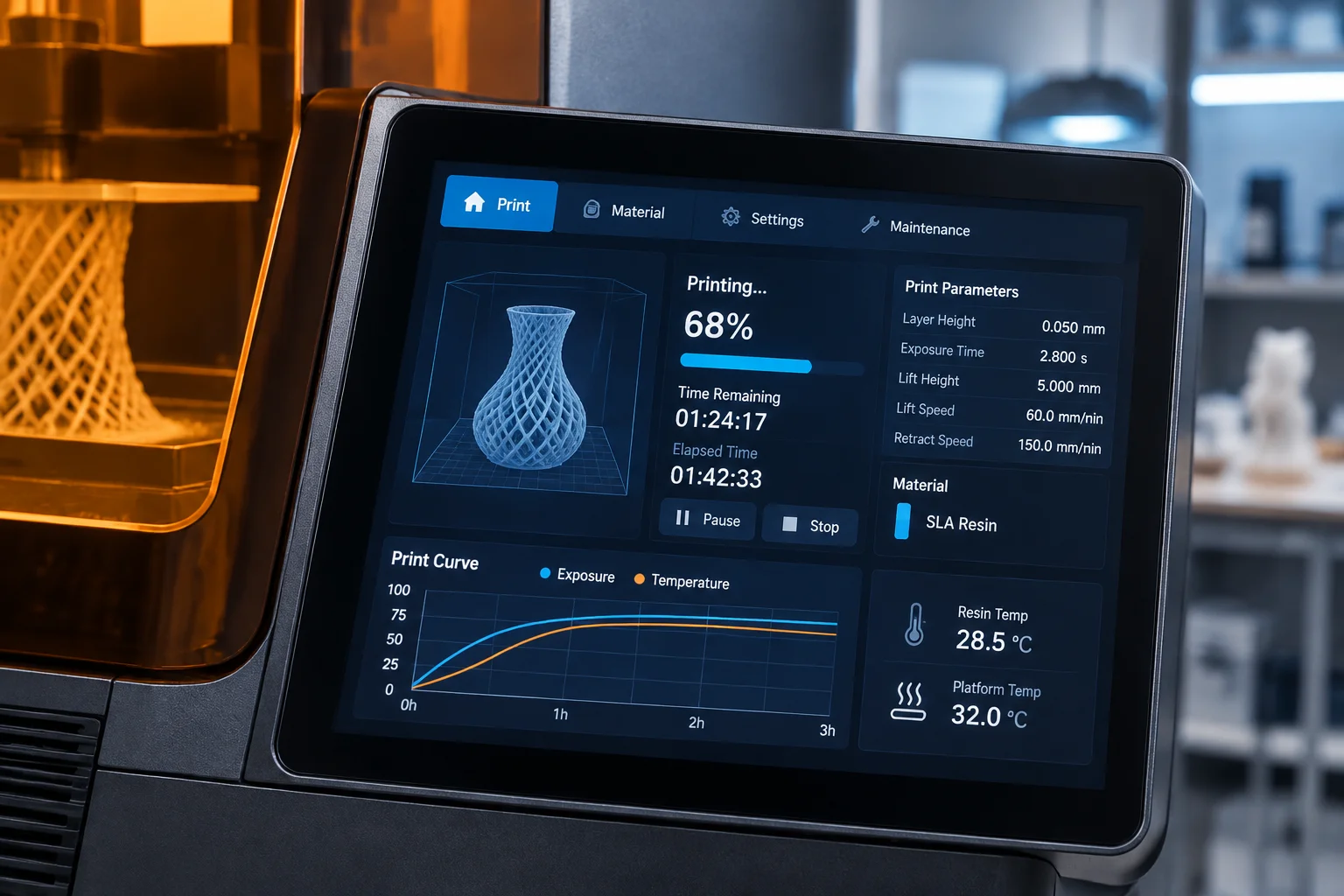
Exposure Calibration and Viscous Recoating Mechanics
Flame-retardant photopolymers rely on microscopic non-halogenated mineral particles and organophosphates that alter ultraviolet penetration and fluid mechanics. As suspended mineral fillers deflect incident laser rays, light diffuses sideways while vertical depth decreases significantly compared to standard prototyping acrylics. Stock machine recipes trigger severe delamination or irregular cross-sectional expansion unless operators reconfigure critical exposure values, mechanical blade velocity, and resin surface equilibration periods before starting production runs.
Calibrated Industrial SLA Parameter Matrix
| Parameter | Value / Technical Scope |
|---|---|
| Critical Exposure (Ec) | 11.8 mJ/cm² (355 nm UV source) |
| Depth of Penetration (Dp) | 0.115 mm (4.5 mils) |
| Nominal Layer Height | 50–100 µm calibrated range |
| Beam Velocity (Hatch / Border) | 3,100 mm/s hatch / 1,450 mm/s border |
| Recoater Sweep Velocity | 22 mm/s (dual-pass sweep) |
| Z-Dip Relaxation Delay | 18.0 seconds post-sweep |
- Regulate vat temperature at 32°C to reduce liquid viscosity without triggering early polymer degradation.
- Extend pre-scan pause intervals beyond 15 seconds to eliminate meniscus surface waves before laser activation.
- Trim outer boundary laser power by twelve percent to counteract lateral photon deflection off mineral additives.
Controlling Mechanical Shear and Lateral Photon Diffusion
Suspended mineral particles give flame-retardant resins non-Newtonian flow properties inside the build reservoir. During the recoating phase, standard wiper speeds exert strong drag forces against fresh green-state supports, pushing slender pillars out of position. Reducing blade speed to 22 mm/s while maintaining a positive meniscus clearance allows the resin to spread evenly across the platform without disturbing fine features.
Lateral photon scatter demands precise beam compensation within pre-print software. Standard offsets fail to counteract ultraviolet photons that bounce off flame-retardant fillers into unexposed liquid. Implementing an alternating 60-degree vector pattern and reducing border beam power prevents heat accumulation, keeping critical snap fits and thin-walled enclosures within intended dimensional boundaries.
Extending the relaxation delay to eighteen seconds eliminated ninety-five percent of interlayer separation issues across our flame-retardant validation builds.