
Equipment Integration and Slicing
Integrating machine firmware protocols with automated slicing software pipelines across industrial Selective Laser Sintering and Digital Light Processing equipment.
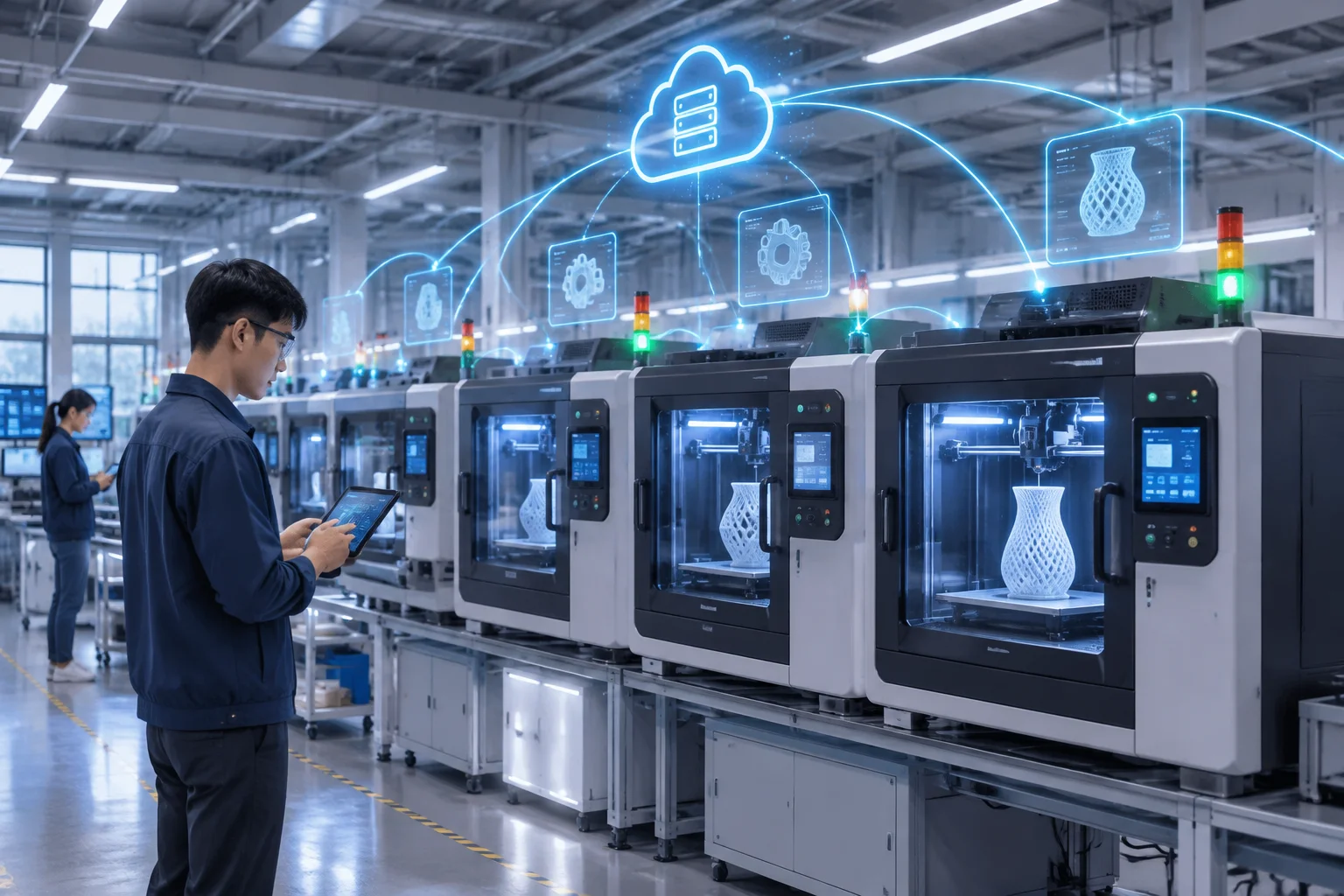
Synchronizing Slicing Engines with Networked Machine Controllers
Modern additive manufacturing facilities require direct digital handshakes between automated slicing software and production hardware. By embedding continuous parameter validation directly into build preparation, engineering teams eliminate disconnects between theoretical scan vectors and real-time chamber conditions across SLS and DLP hardware.
Standard Interface and Slicing Criteria
| Parameter | Value / Technical Scope |
|---|---|
| Protocol Transport Layer | OPC UA Server over TLS 1.3 / Industrial Ethernet |
| SLS Laser Scan Export | Direct CLI / SLC Vector Slices with Hatch Coordinates |
| DLP Mask Generation Format | 4K/8K 16-bit PNG Bitmaps with Subpixel Anti-Aliasing |
| Thermal Feedback Loop Rate | 100 Hz Telemetry Ingestion from IR Chamber Sensors |
| Payload Package Structure | ISO/IEC 25422:2025 Standard 3MF Production Container |
| Firmware Handshake Time | < 250 ms Bidirectional Validation Cycle |
- Standardized container formats package geometry alongside specific machine toolpaths and exposure recipes.
- Real-time feedback loops adapt slicing density based on powder bed temperature gradients and recoater speeds.
- Automated build preparation scripts verify physical chamber volume clearances prior to laser vector transmission.
Bridging CAD Toolpaths with Embedded Factory Controllers
In selective laser sintering systems, slicing software outputs more than raw boundaries; it coordinates hatch direction vectors, laser power ramps, and gas circulation states. Connecting slicing pipelines with machine logic via robust industrial buses ensures that energy delivery precisely accounts for thermal history across each powder layer.
For DLP platforms, pixel irradiance calibration arrays are baked directly into every layer bitmap during execution. As resin vats encounter gradual chemical shifts, connected software drivers compensate with targeted exposure scaling across the projected image, preserving sharp feature definitions across long production runs.
True hardware integration occurs when slicing software stops treating a printer as a passive peripheral and instead treats it as a responsive thermodynamic node on the industrial network.