
Terminology Guide for Additive Manufacturing
Technical review of ISO/ASTM 52900:2021 principles, baseline coordinate systems, and standardized taxonomy across photopolymerization and powder bed fusion systems.
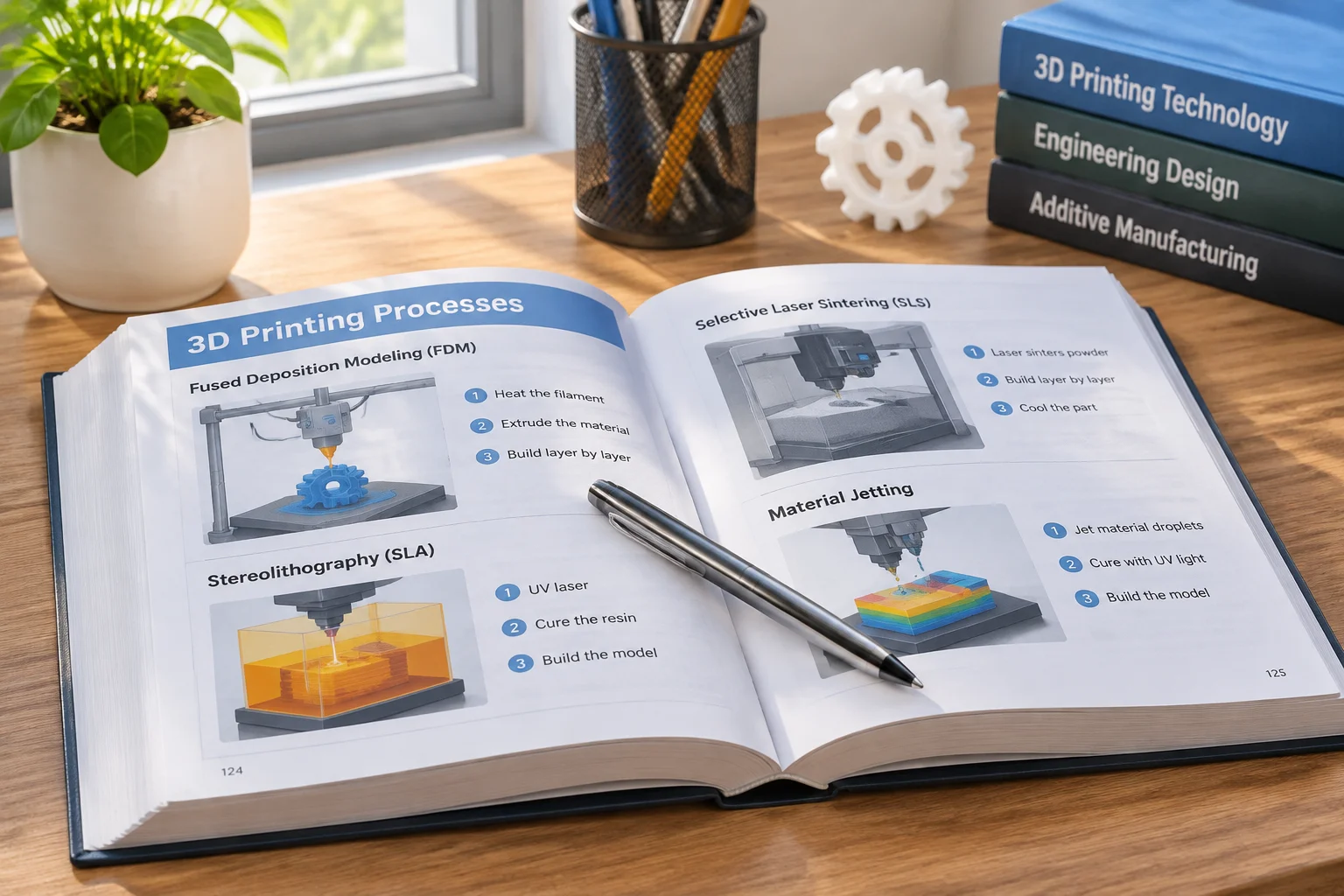
Harmonizing Vocabulary Across Additive Manufacturing Workflows
ISO/ASTM 52900:2021 establishes an unambiguous vocabulary for additive manufacturing technologies, eliminating conflicting trade designations and vendor-specific jargon. By defining the seven fundamental process categories and establishing precise definitions for coordinate reference systems, build orientation, and feedstock conditions, the standard enables reproducible documentation across multi-vendor facilities and regulatory submissions.
Core Architectural Classifications and Definitions
| Parameter | Value / Technical Scope |
|---|---|
| Process Category 1 | Vat Photopolymerization (VPP) - Stereolithography (SLA/DLP) |
| Process Category 2 | Powder Bed Fusion (PBF) - SLS / LPBF Systems |
| Process Category 3 | Material Jetting (MJT) & Binder Jetting (BJT) |
| Process Category 4 | Material Extrusion (MEX) & Directed Energy Deposition (DED) |
| Coordinate Definition | Right-handed orthogonal Cartesian coordinate system (X, Y, Z) |
| Build Plane Nomenclature | Build surface / Substrate / Platform layer orientation |
- Replace proprietary names with standardized process codes (e.g. use Vat Photopolymerization rather than commercial trade terms) in formal inspection sheets.
- Establish the Z-axis strictly perpendicular to the build layer plane, oriented positively in the direction of cumulative layer addition.
- Define feedstock states using uniform physical attributes: liquid monomer viscosity, powder sphericity, and virgin-to-recycled material ratios.
Process Category Breakdown and Coordinate System Integrity
Within technical documentation, distinguishing between process mechanics and machine configuration preserves engineering clarity. Under ISO/ASTM 52900:2021, Vat Photopolymerization encompasses any additive process wherein liquid photopolymer in a vat is selectively cured by light-activated polymerization, irrespective of whether irradiation occurs from the bottom-up or top-down. This distinction ensures consistent data structures across resin slicing software, platform schemas, and quality assurance logs.
Equally rigorous is the definition of build volume orientation. Machine coordinates must resolve into a right-handed orthogonal system where the positive Z-axis aligns strictly with the layer stacking vector. Documenting component layout relative to the build platform requires explicit angle declarations (roll, pitch, yaw) relative to primary machine axes, preventing misinterpretation during downstream mechanical qualification.
Standardized nomenclature is not merely academic cataloging; it constitutes the foundational substrate that allows automated slicing toolpaths, digital project trees, and regulatory filings to communicate without semantic error.