
SLA Platform Top-Down Schema Standards
Technical specifications and 2D projection rules for documenting resin stereolithography build plates, support envelopes, and clearance matrices.
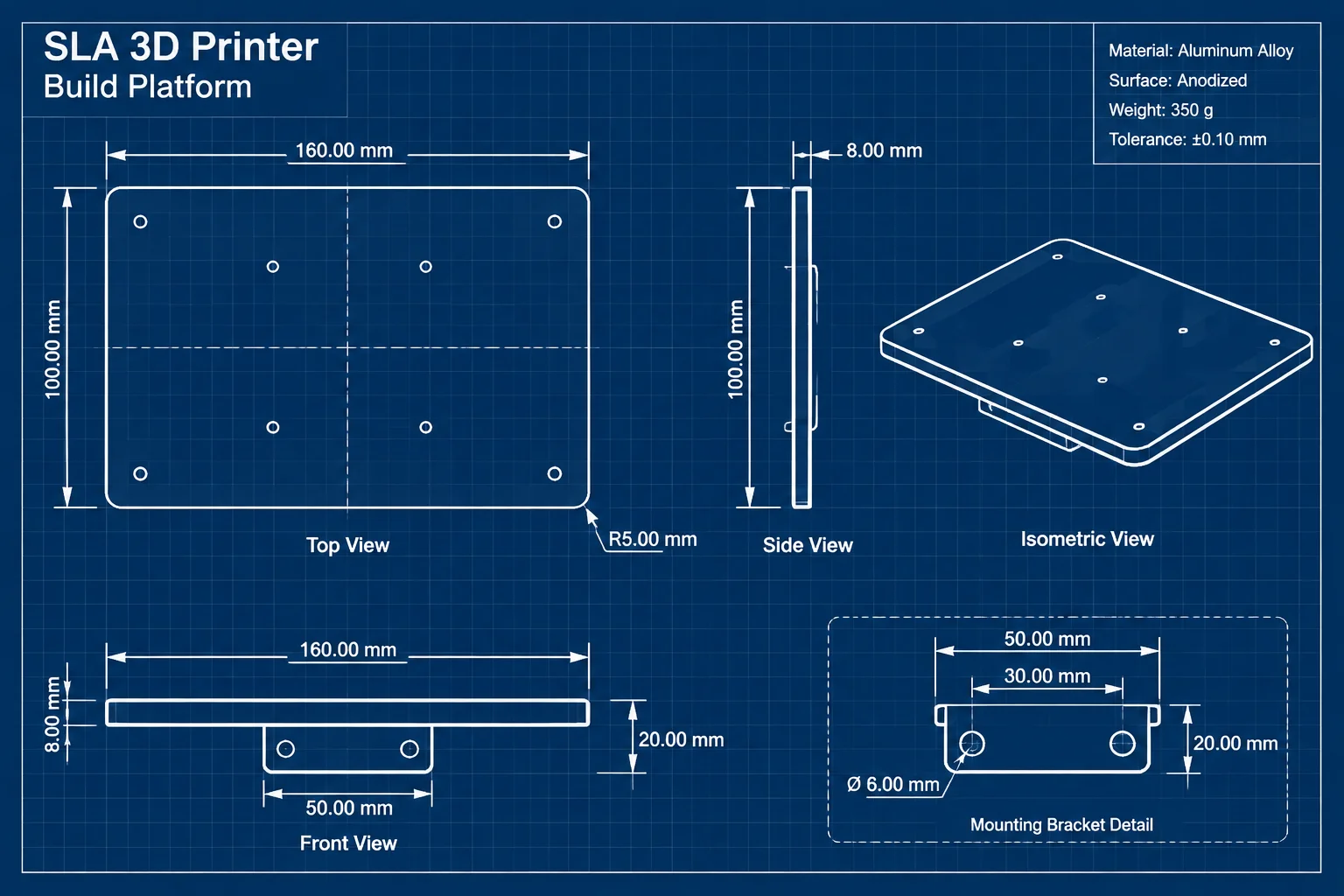
Unified 2D Layout Geometry for SLA Resin Platforms
SLA platform top-down schemas establish a standardized orthographic projection format for documenting part arrangement, drain orientations, and peel-force distribution across vat photopolymerization systems. By aligning the platform coordinate datum with the mechanical wiper or recoater sweep vector, production teams eliminate orientation ambiguities across machine operators and automated pre-print inspection scripts.
Platform Documentation Parameter Matrix
| Parameter | Value / Technical Scope |
|---|---|
| Coordinate System Origin (Datum) | Center-aligned (0,0,0) or mechanical front-left corner datum |
| Grid Division Pitch | 10.0 mm primary grid with 2.0 mm secondary sub-divisions |
| Edge Clearance Boundary | Minimum 12.0 mm exclusion margin along vat border |
| Suction Cup Angle Annotation | Vector arrow indicating lowest drain point and vent hole |
| Support Silhouette Boundary | 1.5 mm projected perimeter envelope around part shadow |
| Part Identification Labeling | Monospaced UID string (AM-XXXX) within bounding box |
- Define the wiper blade recoat direction explicitly with a directional vector arrow on every layout export.
- Maintain minimum 8.0 mm inter-part spacing to prevent cross-cure scattering and hydraulic suction pooling.
- Tag cross-sectional surface area peaks on the schema timeline to balance platform peel loads.
Standardizing 2D Build Exports for Industrial Vat Platforms
Industrial photopolymerization workflows depend on clear communication between digital preparation environments and production floor operators. Orthographic 2D representations strip away distracting UI artifacts and render pure geometric silhouettes, drainage orientations, and contact patch clusters. This clarity helps build plates loaded into industrial stereolithography machinery match verified clearance envelopes without manual guesswork.
In top-down documentation schemas, every assembly component is identified by its registered UID and bounding envelope. Annotations highlight potential resin trapping pockets and verify vent placement relative to the recoater trajectory. As vat sizes scale past 500 mm build envelopes, top-down standardization prevents excessive peel velocity across large cross-sections, protecting both silicone membranes and delicate support matrices.
Standardizing the 2D build schema provides technicians with an unambiguous blueprint of peel tension distribution, reducing platform failures before the vat ever fills with resin.