
Project Tree and Assembly Documentation
Technical requirements for structuring nested assemblies, digital project trees, parent-child component schemas, and part tracking IDs across additive manufacturing builds.
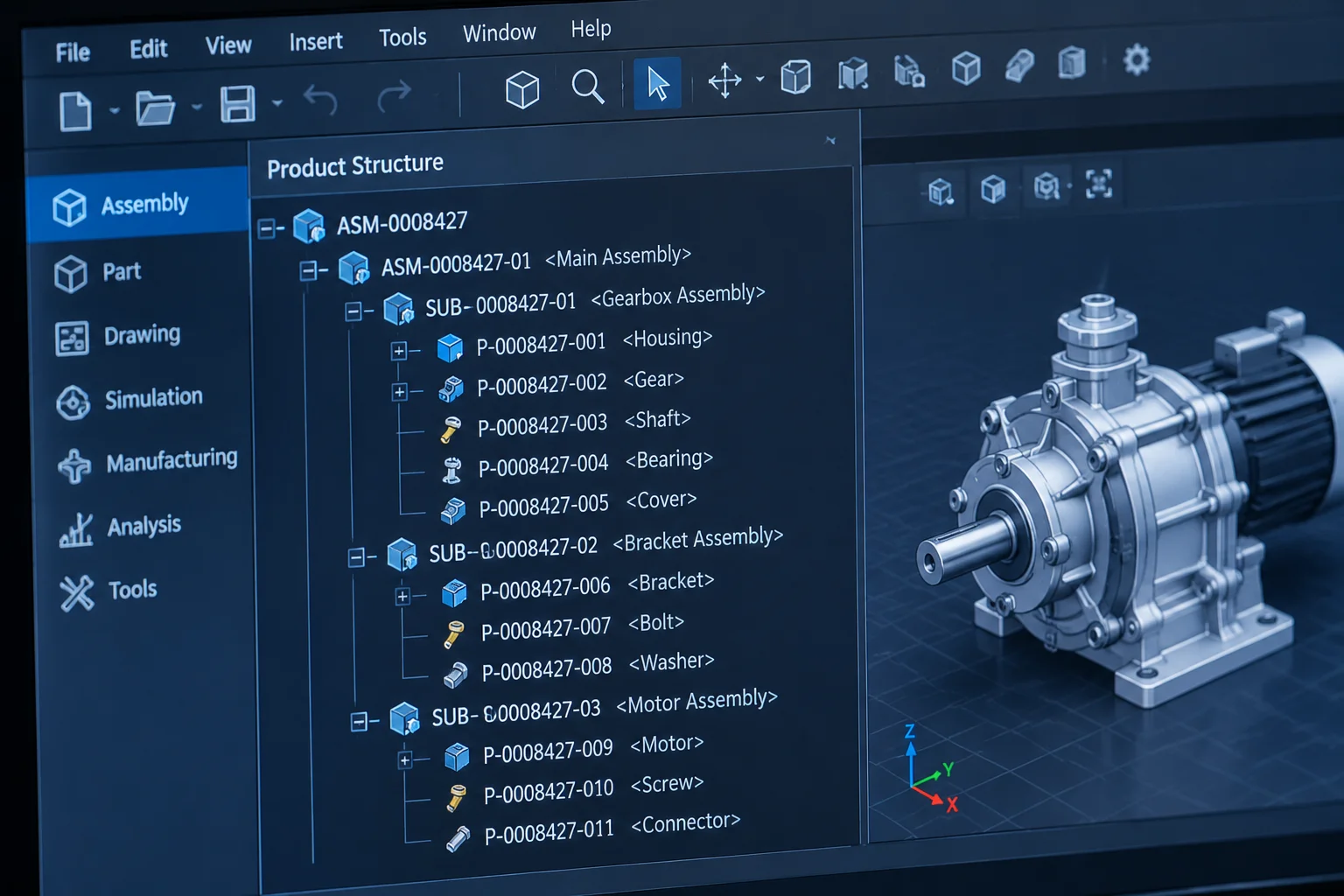
Organizing Complex Multi-Part Build Trees
Industrial additive manufacturing projects that combine numerous mating components demand unambiguous project hierarchy structures. Instead of flattening CAD data into disconnected solid meshes, standard project tree documentation maintains node parenting, coordinate reference baselines, and unique alphanumeric designations. This documentation protocol prevents component confusion during tray layout preparation, support generation, post-cure sorting, and final mechanical assembly verification.
Tree Schema Specification Matrix
| Parameter | Value / Technical Scope |
|---|---|
| Node Nesting Depth | Up to 5 hierarchical levels (Root > Subassembly > Sub-tier > Component > Shell) |
| Part ID Nomenclature | Tabular monospace alphanumeric syntax [PRJ-SUB-0000-REV] |
| Spatial Reference Frame | Universal build plate origin [0,0,0] maintained across sub-nodes |
| Material Metadata Linking | Node-level assignment for resin density, photopolymer tint, or PA12 grade |
| File Container Protocol | Native 3MF production extension with XML object relational manifests |
| Tolerance Allocation Tagging | Interference and clearance gap bounds documented in node attributes |
- Preserve coordinate origins within subassembly nodes so mating components orient identically during slicer import.
- Assign discrete tabular monospace IDs to every distinct part shell to simplify post-print inspection and sorting.
- Separate multi-part assemblies logically before nesting across distinct build envelopes or different material tanks.
Preserving Relational Integrity Across the Slicing Pipeline
When mechanical prototypes transition from high-density computer-aided design into slicer environments, raw geometry conversion often discards relational assembly trees. Retaining a clear project tree eliminates guessing during orientation optimization. Component groupings allow machine operators to apply uniform SLA inclination angles or SLS thermal spacing without breaking mechanical alignment constraints between interdependent moving linkages.
In high-mix additive production, assembly sheets act as the authoritative blueprint between digital preparation and physical staging. By annotating each subassembly node with material attributes, clearance dimensions, and build plate assignment, manufacturing teams track every fastener pocket, hinge pin, and housing lid from washing tanks to inspection benches without losing component provenance.
A robust project tree transforms an untamed cloud of individual polygons into an auditable mechanical manufacturing journey.